Wednesday, November 3, 2010

Book Review: Jenna and Jonah's Fauxmance by Brendan Halpin and Emily Franklin


Jenna and Jonah's Fauxmance by Brendan Halpin & Emily Franklin
Publisher: Walker Books for Young Readers
Publish Date: February 1, 2011
Paperback, 240 pages
Young Adult


My Review:
Why I read this:  I received this through Good Golly Miss Molly's tour.

How is the novel driven: Character, this is about Jenna and Jonah.

My thoughts: This is a really cute and fun book.  While somewhat predictable, the fun is still getting to the conclusion and the characters learning about themselves.  My son asked me this question this morning "I've heard that sometimes when a girl likes you, she will treat you mean, is that true?"  That question sums this book up perfectly.

Jenna and Jonah have been thrown together on their tv show for years and then into a fake relationship because it made the fans happy and drove up ratings.  But truthfully they can't stand each other, or can they?  Jenna will do anything to keep the show running and her ratings high, Jonah just wants out.  Then the unthinkable happens.  A scandal occurs and the show is toast.  Now what will Jenna and Jonah do?

I sped through this book and found it highly entertaining.  The verbal sparring between Jenna and Jonah is fun.  The agents are crazy and when Jenna and Jonah come together again to work on a project the sparks fly in good and bad ways.

The characters are well-developed and I felt like this was a fun look into the life of teenage stars.  I really enjoyed reading about Jenna and Jonah and look forward to future books by these authors.


My Rating: 4.5/5.0

About the Book:

Fans of romance don't need to look any further than the fauxmance brewing between teen idols Charlie Tracker and Fielding Withers—known on their hit TV show as Jenna and Jonah, next-door neighbors flush with the excitement of first love. But it's their off-screen relationship that has helped cement their fame, as passionate fans follow their every PDA. They grace the covers of magazines week after week. Their fan club has chapters all over the country. The only problem is their off-screen romance is one big publicity stunt, and Charlie and Fielding can't stand to be in the same room. Still, it's a great gig, so even when the cameras stop rolling, the show must go on, and on, and on. . . . Until the pesky paparazzi blow their cover, and Charlie and Fielding must disappear to weather the media storm. It's not until they're far off the grid of the Hollywood circuit that they realize that there's more to each of them than shiny hair and a winning smile.
About the Author:

Emily Franklin collaborated with Brendan Halpin for their novel The Half-Life of Planets. She has also written a dozen novels for young adults, including the Principles of Love series and The Other Half of Me, and she edited It's a Wonderful Lie: 26 Truths About Life in Your Twenties. Emily's work has also appeared in The Boston Globe and national magazines. She lives in Massachusetts.

Brendan Halpin was a high school English teacher for ten years before penning his first novel. He is the author of How Ya Like Me Now and Forever Changes, as well as several novels for adults. He lives in Boston, Massachusetts.
Emily's website 
Brendan's website  
Brendan's Twitter

FTC Information: I received this book through Good Golly Miss Molly's tour for review.  I have Amazon links on my review pages but I do not make any money from these because of NC laws.  I put them solely for people to check out the books on a retail site.

Monday, November 1, 2010

Book Tour and Review: Buying Time by Pamela Samuels Young (+ Giveaway)


Buying TimeBuying Time by Pamela Samuels Young
Publisher: Goldman House Publishing
Publish Date: November 9, 2009
Paperback, 370 pages
Suspense/Thriller, Legal Thriller


My Review:
Why I read this:  I was approached for her Pump Up Your Book Promotions Tour and Buying Time sounded like a book that was right up my alley.

How is the novel driven:  Plot driven, characters are important, but the plot is what drives the book

My thoughts:  I started this on Saturday morning and had it finished by Saturday evening.  Granted my kids were not home, but I did have laundry, a nap and several other Saturday chores to do or I probably would have finished the book in about 4 hours.  Once you pick Buying Time up you will have a very hard time putting it down.

I'll start with the characters, they are essential, but not what drives the novel.  I love a novel that sets a bunch of characters up in the first 100 pages or so and you know that even though they have very little in common, somehow by the end of the book they will all intertwine.  It was fascinating to watch how it all worked out.  I relaly like Angela, she was a strong woman, a lawyer, a pretty woman, but she had troubles too.  She didn't want to be in the relationship she's in and her mother is one of those who is always coming down on her.  Then Angela meets Dre and she feels different and even stronger.  But Dre has his secrets.  And then there is Waverly.  If there was ever a character who tries to do right but can't seem to get a break, it's Waverly.  He's not without his faults as well, but for the most part I found myself cheering for him in the book.

The book is gritty and it's real.  I learned something about the branch of insurance that buys out policies on terminal cases.  Very sad in a way yet very helpful in another.  The characters in this seem real and I like how the author deals with each character.  Angela, and Ivy League grad and lawyer, a black woman at the top of her game.  Dre with his problems is more of a street guy, but extremely smart.  Waverly, is a little out there and just wants to make money.  Then of course there are the bad guys and that secondary plot is pretty twisted as well.

If you want a non-stop legal thrillride, then Buying Time is the book for  you.  I can't believe I haven't heard of this author before.  If you havent' heard of her, I suggest reading Buying Time and then I think you will be hooked.  I think we will continue to hear much more out of Ms. Young in the future, I honestly think she could rival any work by John Grisham (who I love) any day and I look forward to reading her backlist.  She has a great way with characters and creating thrilling and suspenseful but believable situations.


My Rating: 4.75/5.0

About Pamela Samuels Young

Corporate attorney Pamela Samuels Young has always abided by the philosophy that you create the change you want to see. Fed up with never seeing women or people of color depicted as savvy, hot shot attorneys in the legal thrillers she read, Pamela decided to create her own characters. Despite the demands of a busy legal career, Pamela accomplished her ambitious goal by rising at four in the morning to write before work, dedicating her weekends to writing and even spending her vacation time glued to her laptop for ten or more hours a day.
Pamela Samuels YoungThe Essence magazine bestselling author now has four fast-paced legal thrillers to show for her efforts: Every Reasonable Doubt (BET Books, February 2006), In Firm Pursuit (Harlequin, January 2007), Murder on the Down Low (Goldman House Publishing, September 2008) and Buying Time (Goldman House Publishing, November 2009). New York Times bestselling author Sheldon Siegel described Buying Time, Pamela’s first stand-alone novel, as a “deftly plotted thriller that combines the best of Lisa Scottoline and Robert Crais.”
Pamela has achieved a successful writing career while working as Managing Counsel for Labor and Employment Law for a large corporation in Southern California. Prior to that, she served as Employment Law Counsel for Raytheon Company and spent several years with the law firm of O’Melveny & Myers, LLP in Los Angeles. A former journalist, Pamela began her broadcasting career as a production assistant at WXYZ-TV in Detroit, where she was quickly promoted to news writer. To escape the chilly Detroit winters, she returned home to Los Angeles and worked at KCBS-TV as a news writer and associate producer.
Pamela has a bachelor’s degree in journalism from USC, a master’s degree in broadcasting from Northwestern University’s Medill School of Journalism and received her law degree from UC Berkeley’s Boalt Hall School of Law. She currently serves on the Board of Directors of the Southern California Chapter of Mystery Writers of America and is the Fiction Expert for BizyMoms.com.
Pamela is a frequent speaker on the topics of discrimination law, diversity, writing and pursuing your passion. She is married and lives in the Los Angeles area. To contact Pamela or to read an excerpt of her books, visit www.pamelasamuelsyoung.com.

Website 
Facebook 
Twitter 

About Buying Time

Buying Time is a scandalous tale of blackmail, murder and betrayal, evoking John Grisham with a dash of Terry McMillan.
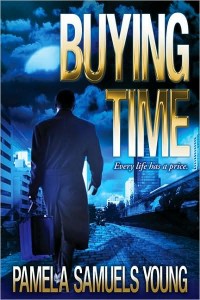
Buying Time 2Waverly Sloan is a down-on-his-luck lawyer. But just when he’s about to hit rock bottom, he stumbles upon a business with the potential to solve all of his problems.
In Waverly’s new line of work, he comes to the aid of people in desperate need of cash. But there’s a catch. His clients must be terminally ill and willing to sign over rights to their life insurance policies before they can collect a dime. Waverly then finds investors eager to advance them thousands of dollars—including a hefty broker’s fee for himself—in exchange for a significant return on their investment once the clients take their last breath.
The stakes get higher when Waverly brokers the policy of the cancer-stricken wife of Lawrence Erickson, a high-powered lawyer who’s bucking to become the next U.S. Attorney General. When Waverly’s clients start dying sooner than they should, both Waverly and Erickson—who has some skeletons of his own to hide—are unwittingly drawn into a perilous web of greed, blackmail and murder.
Soon, a determined federal prosecutor is hot on Waverly’s trail. But when the prosecutor’s own life begins to unravel, she finds herself on the run—with Waverly at her side.

Book Excerpt

PROLOGUE
Veronika Myers tried to convince them, but no one would listen. Her suspicions, they said, were simply a byproduct of her grief.
Each time she broached the subject with her brother, Jason, he walked out of the room. Darlene, her best friend, suggested a girls’ night out with some heavy drinking. Aunt Flo urged her to spend more time in prayer.
Veronika knew she was wasting her time with this woman, too, but couldn’t help herself.
“My mother was murdered,” Veronika told the funeral home attendant. “But nobody believes it.”
The plump redhead with too much eye shadow glanced down at the papers on her desk, then looked up. “It says here that your mother died in the hospital. From brain cancer.”
“That’s not true,” Veronika snapped, her response a little too sharp and a tad too loud.
Yes, her mother had brain cancer, but she wasn’t on her deathbed. Not yet. They had just spent a long afternoon together, laughing and talking and watching All My Children. Veronika could not, and would not accept that the most important person in her life had suddenly died. She knew what everyone else refused to believe. Her mother had been murdered.
“Did they conduct an autopsy?” the woman asked.
Veronika sighed and looked away. There had been no autopsy because everyone dismissed her as a grief-stricken lunatic. When she reported the murder to the police, a disinterested cop dutifully took her statement, but she could tell that nothing would come of it. Without any solid evidence, she was wasting everyone’s time, including her own.
“No,” Veronika said. “There wasn’t an autopsy.”
The funeral home attendant smiled sympathetically.
Veronika let out a long, exasperated breath, overwhelmed by the futility of what she was trying to prove. “Never mind,” she said. “What else do you need me to sign?”
* * *
Later that night, Veronika lay in bed, drained from another marathon crying session. She rummaged through the nightstand, retrieved a bottle of sleeping pills and popped two into her mouth. She tried to swallow them dry, but her throat was too sore from all the crying.
Tears pooled in her eyes as she headed to the kitchen for a glass of water. “Don’t worry, Mama,” Veronika sniffed. “I won’t let them get away with it.”
Just as she reached the end of the hallway, a heavy gloved hand clamped down hard across her mouth as her arms were pinned behind her back. Panic instantly hurled her into action. Veronika tried to scream, but the big hand reduced her shriek to a mere muffle. She frantically kicked and wrestled and twisted her body, but her attacker’s grip would not yield.
When she felt her body being lifted off the ground and carried back down the hallway, she realized there were two of them and her terror level intensified. But so did her survival instinct. She continued to wildly swing her legs backward and forward, up and down, right and left, eventually striking what felt like a leg, then a stomach.
As they crossed the threshold of her bedroom, she heard a loud, painful moan that told her she had likely connected with the groin of one of her assailants.
“Cut it out!” said a husky, male voice. “Grab her legs!” he ordered his partner. “Hurry up!”
The men dumped her face down onto the bed, her arms still restrained behind her back. The big hand slipped from her mouth and Veronika’s first cry escaped, but was quickly muted when a much heavier hand gripped the back of her neck and pressed her face into the comforter.
Fearing her attackers were going to rape, then kill her, Veronika defiantly arched her back and tried to roll her body into a tight ball. At only 130 pounds, she was no physical match for her assailants. They easily overpowered her, forcing her back into a prone position. As one man sat on her upper legs, strapping her left arm to her side, the other man bent her right arm at the elbow and guided her hand up toward her forehead.
During the deepest period of her grief, Veronika had longed to join her mother. But now that she was face-to-face with the possibility of death, she fought valiantly for life.
That changed, however, the second Veronika felt something cold and hard connect with her right temple. She stiffened as one of the men grabbed her fingers and wrapped them around the butt of a gun. At that precise instant, Veronika knew with certainty that her suspicions were indeed fact. Her mother had been murdered and now the same killers had come to silence her before she could expose the truth. And just like her mother’s death, her own murder would go undetected, dismissed as the suicide of a grieving daughter. A conclusion no one would question.
As the man placed his hand on top of hers and prepared to pull the trigger, a miraculous, power-infused sensation snuffed out what was left of Veronika’s fear, causing her body to go limp. The heavy pounding of her heart slowed and she felt light enough to float away.
Completely relaxed now, Veronika closed her eyes, said a short prayer, and waited for a glorious reunion with her mother.

banner-bar1

BUYING TIME’S NOVEMBER ‘10 TOUR SCHEDULE

banner-bar1 
Monday, November 1
Book Reviewed at My Reading Room
Tuesday, November 2
Interviewed at My Reading Room
Wednesday, November 3
Book Reviewed at Peaceful Reader
Thursday, November 4
Guest Blogging at Peaceful Reader
Monday, November 8
Book Reviewed at Bonjour Cass
Thursday, November 11
Book Reviewed at My Favorite Things
Monday, November 15
Book Reviewed at Marta’s Meanderings

banner-bar1
Giveaway:

I would like to giveaway my copy of Buying Time to one lucky commentor.  Open to US/Canada only.  Comment and tell me what your favorite sub-genre of suspense is (legal, medical, etc.).  Extra entries for following (GFC, email, RSS, twitter, GoodReads, Facebook, etc).  Other entries for tweeting and blogging about.  Leave a single comment or separate comments.  Giveaway open through 11/9.

FTC Information: Special thanks to the author for sending me a review copy.  All opinions expressed are my own and they are my honest opinions, I am not compensated anything beyond receiving the book for review.  I have Amazon links on my review pages but I do not make any money from these because of NC laws.  I put them solely for people to check out the books on a retail site.

FIRST Wild Card Tour: The Black Madonna by Davis Bunn

It is time for a FIRST Wild Card Tour book review! If you wish to join the FIRST blog alliance, just click the button. We are a group of reviewers who tour Christian books. A Wild Card post includes a brief bio of the author and a full chapter from each book toured. The reason it is called a FIRST Wild Card Tour is that you never know if the book will be fiction, non~fiction, for young, or for old...or for somewhere in between! Enjoy your free peek into the book!

You never know when I might play a wild card on you!


Today's Wild Card author is:


and the book:

Touchstone; 1st edition (September 7, 2010)
***Special thanks to Libby Reed, Publicity Assistant, HOWARD BOOKS, a division of Simon & Schuster for sending me a review copy.***

***My review will be posted later today. ***

ABOUT THE AUTHOR:


Davis Bunn is an award winning author who serves as writer in residence at Regent’s Par College, Oxford University. His novels have sold more than six million copies in sixteen languages.

Photograph by I.D. Bunn

Visit the author's website.

Product Details:

List Price: $14.99
Paperback: 336 pages
Publisher: Touchstone; 1st edition (September 7, 2010)
Language: English
ISBN-10: 1416556338
ISBN-13: 978-1416556336

AND NOW...THE FIRST CHAPTER:


FROM THE CREST OF THE Herodium dig, Harry Bennett could look out and see three wars.

The isolated, cone-shaped hill rose two thousand feet over the Judean Desert. Herodium, the palace-fortress built by Herod the Great, had been erected on the site of his victory against the Parthians in 40 BCE. Herod had then served as king of Judea under his Roman masters, but he had been utterly despised by the Judeans. When Herod's sons were finally vanquished, Herodium had been evacuated. Over the centuries, the city became a legend, its location a myth.

Modern excavations had begun in the sixties, only to be interrupted by wars and intifadas and disputes over jurisdiction. Harry Bennett was part of a group excavating the original palace fortress. The current project was supervised by a woman professor from the Sorbonne. She had fought for six years to gain the license, and nothing so minor as somebody else's war was going to stop her work.

The volunteers came from a dozen nations, to dig and learn and bury themselves in history. Most were in their twenties and tried to keep up a brave face despite the rumbles of conflict and the brutal heat. The day Harry arrived at Herodium, three Scandinavian backpackers had perished hiking above the Ein Gedi National Forest. With water in their packs. Just felled by the ferocious heat.

And here Harry was, huddled under the relentless glare of that same deadly sun, using his trowel and his brush to scrape two thousand years of crud off a stone.

Officially Harry and the other volunteers were restricted to the dig and their hilltop camp. With Hamas missiles streaking the nighttime sky, none of the other unpaid staff were much interested in testing their boundaries. But twice each week the Sorbonne professor traveled to Jerusalem and delivered her finds to the ministry. When she departed that particular afternoon, Harry signaled to the Palestinian operating the forklift. Ten minutes later, they set off in Hassan's decrepit pickup.

The angry wind blasting through his open window tasted of sand as dry as volcanic ash. Hassan followed the pitted track down an incline so steep Harry gripped the roof and propped one boot on the dashboard. He tried to ignore the swooping drop to his right by studying the horizon, which only heightened his sense of descending into danger. North and east rose the Golan hills and sixty years of struggle with Syria. Straight north was the Lebanese border, home to the Hezbollah hordes. To the southwest lay Gaza, provider of their nightly firework displays.

All West Bank digs were required to employ a certain number of locals. Hassan was one of the few who arrived on time, did an honest day's work, and showed a keen interest in every new discovery. On Harry's first day at the site, he had put the man down for a grave robber and a smuggler.

The West Bank was the richest area for artifacts in all Judea. There were thousands of sites, many dating from the Iron Age, others from the Roman era, and more still from Byzantium. Many sites remained undiscovered by archeologists but were well known to generations of Palestinians, who fiercely guarded their troves and passed the locations down from generation to generation.

Hassan's former job wouldn't have sat well with the Israeli authorities. But people like Hassan took the long view. Eventually things would settle down, and when they did, Hassan would return to his real trade. In the meantime, Hassan hid his profession from the Israeli authorities, lay low, and remained open to a little persuasion. In Harry's case, that amounted to a thousand dollars.

They arrived in Hebron three hours later. The city crawled up the slopes of two hills and sprawled across a dull desert bowl. Entering Hebron around sunset, in the company of a Palestinian smuggler, was an act of total lunacy.

Harry Bennett wouldn't have had it any other way.

Clustered on hilltops to the north of the old city rose the UN buildings, the university, and a huddle of government high-rises built with international relief funding. Other hills were dominated by Jewish settlements. These were rimmed by fences and wire and watchtowers that gleamed in the descending light. The rest of Hebron was just your basic war zone.

Sunset painted Hebron the color of old rust. The city held the tightly sullen feel of a pot that had boiled for centuries. Even the newer structures looked run-down. Most walls were pockmarked with bullet holes and decorated with generations of graffiti. Harry saw kids everywhere. They bore such tight expressions they resembled old people in miniature. Looking into their eyes made Harry's chest hurt.

The streets were calm, the traffic light. Which was good, because it allowed them to make it to the city center early. It was also bad, because the Israel Defense Forces soldiers had nothing better to do than watch Hassan's truck. Two IDF soldiers manning a reinforced guard station tracked the pickup with a fifty-caliber machine gun.

Hassan said, "This idea is not so good, maybe."

Harry nodded slowly. He smelled it too, the biting funk of cordite not yet lit. But he would trust his driver. "You say go, we go."

Hassan's gaze flitted over to Harry. "You pay?"

"The deal's the same. You get the other five hundred when we're done."

Hassan wiped his face with a corner of his checkered head-kerchief. "We stay."

Harry halfway wished the man's nerve would fail and he would turn his rattling truck around. "Better to come in twice than not go home at all."

"You know danger?"

"Some."

"I think maybe more than some. I think you see much action."

"That was then and this is now," Harry replied. "You're my man on the ground here. I'm relying on your eyes and ears. I can't tell what's real and what's just your normal garden-variety funk."

Hassan skirted a pothole large enough to swallow the neighboring Israeli tank. "Say again, please."

"Let's assume for a second that you and I can do business together."

Hassan pointed at Harry's shirt pocket holding the five bills—the rest of his fee. "This is not business?"

"I'd call it a first step. Say your man shows up like you promised. Say he's got the goods and the buy goes well. What happens next?"

"If the first buy goes well, you trust me for more."

"Right. But I need someone who can sniff out traps and see through walls. There's so much danger around here, my senses are on overload."

The man actually smiled. "Welcome to Hebron."

"I didn't go to all this trouble for just one item, no matter how fine this guy's treasure might be. I need you to tell me if we're safe or if we should pull out and return another time."

Hassan did not speak again until he parked the truck and led Harry into a cafÉ on Hebron's main square. "What you like?"

"You mean, other than getting out of here with my skin intact? A mint tea would go down well."

Hassan placed the order and settled into the rickety chair across from Harry. "There are many Americans like you?"

"I'm one of a kind."

"Yes. I think you speak truth." Hassan rose to his feet. "Drink your tea. I go ask what is happening."

All Harry could do was sit there and watch the only man he knew in Hebron just walk away. From his spot by the bullet-ridden wall, isolated among the patrons at other tables who carefully did not look his way, Harry felt as though he had a bull's-eye painted on his forehead. Even the kid who brought his tea and plate of unleavened bread looked scared. Harry stirred in a spoonful of gray, unrefined sugar and lifted the tulip-shaped glass by its rim. All he could taste was the flavor of death.

AFTER SUNSET, THE HEBRON AIR cooled at a grudging pace. Harry watched as the city square filled with people and traffic and shadows. The cafÉ became crowded with people who avoided looking Harry's way. Across the plaza, the Tomb of the Patriarchs shone pearl white. Beside the cave complex stood the Mosque of Abraham, a mammoth structure dating back seven hundred years.

The caves had been bought by the patriarch Abraham for four hundred coins, such an astronomical sum that the previous owner had offered to throw in the entire valley. But Abraham had insisted upon overpaying so that his rightful ownership would never be questioned. He had wanted the caves as his family's burial site because supposedly they were also where Adam and Eve had been laid to rest. Besides Abraham himself, the caves also held the remains of his wife, Sarah, along with Rebecca, Isaac, and Jacob.

The guy who made his way toward Harry's table resembled an Arab version of the Pillsbury Doughboy. The man waddled as he walked. His legs splayed slightly from the knees down. His round face was topped by flattened greasy curls that glistened in the rancid lights of the cafÉ. He walked up, slumped into the chair across the table from Harry, and demanded, "You have money?"

Harry kept his gaze on the square and the crawling traffic. "Where's Hassan?"

"Hassan is not my business. He is your business. You must answer my question. You have money?"

Harry was about to let the guy have it when he spotted Hassan returning across the plaza. When he reached the cafÉ's perimeter, Hassan seated himself at an empty table, facing outward toward the plaza, placing himself between Harry and any incoming threat. Harry relaxed slightly. It was always a pleasure doing business with a pro.

Harry said, "Let's take this from the top. I'm—"

"I know who you are. Harry Bennett seeks treasure all over the world. You see? We meet because I check you out."

"What's your name?"

"Wadi Haddad."

"Wadi, like the word for oasis?"

"Yes, is same." He wore a rumpled linen jacket, its armpits wet and darkened with sweat. He reached in a pocket and came up with a pack of filterless Gitanes. "You want?"

"Never learned to use them, thanks."

Wadi Haddad lit the cigarette with a gold lighter. The stench of black tobacco encircled the table. "I have much interesting items. Very nice."

"I didn't come to Hebron for nice, Mr. Haddad. I came for exceptional. You understand that word?"

"Exceptional is also very expensive."

"One of a kind," Harry went on. "Unique. Extremely old. And I have always been partial to gold."

Wadi Haddad revealed a lizard's tongue, far too narrow for his globular face. It flitted in and out several times, tasting the air. "How much money you have?"

"Not a cent with me."

"Then I also have nothing. Business is finished." But Wadi Haddad did not move.

"Here's how it's going to work," said Harry. "You show me the item. I photograph it."

"No. Photographs absolutely not to happen."

"I show the photographs to my clients. If they like, they transfer the money to an escrow account at the Bank of Jordan in Amman. You understand, escrow?"

"I know."

"Good. Then you bring the item to Jerusalem and we make the exchange."

"Not Jerusalem. Too much police everyplace."

"Okay, Mr. Haddad. Where would you prefer?"

"Petra."

"Too small. I like bright lights, big city."

"Then Amman."

Which had been Harry's choice all along. Even so, he pretended to give that some thought. "Okay, Amman. Hotel Inter-Continental. You got an account at the Bank of Jordan?"

"I make one happen."

"Then we're ready to roll. All we need is the merchandise."

"No photographs."

"Then no business. Sorry, Charlie."

"My name is Wadi."

"Whatever. I don't shoot, I don't buy."

"Photographs cost you a thousand dollars."

Suddenly Harry was very tired of this two-step. "Fine. But I take the thousand from the final purchase price. And don't even think of arguing."

Wadi Haddad did not rise so much as bounce from the seat. "Okay, we go. Not your man." He nodded toward Hassan. "Just you."

"Be right with you." Harry walked to Hassan's table and squatted down beside the man's chair. "You find anything?"

"Hebron is one tense city. People very worried."

"Yeah, I caught that too." Harry liked how the guy never stopped searching the shadows. "Where'd you see action, Hassan?"

"Nowhere. I see nothing, I do nothing. In the West Bank there is only IDF and terrorists."

"Wadi's taking me to check out the merchandise. He says I've got to do this alone. You think maybe you could watch my back?"

"Is good." Hassan held to a catlike stillness. "I see something, I whistle. I can whistle very loud."

Harry rose to his feet, patted the guy's shoulder, and said, "You just earned yourself another five bills."

WADI HADDAD MOVED SURPRISINGLY FAST on his splayed legs. He led Harry deep into the old city. The West Bank crisis was etched into every Hebron street, every bullet-ridden wall, every building topped by an IDF bunker. The streets were either dimly lit or not at all. But walking behind the wheezing Haddad, Harry had no trouble picking his way through the rubble. Behind him, the mosque and the cave complex shone like beacons. And up ahead loomed the wall.

The barrier separating the Jewish sector from Hebron's old city was thirty feet high and topped with razor wire. Searchlights from the guard towers and nearby IDF bunkers serrated the night. The wall gleamed like a massive concrete lantern.

Somewhere in the distance a truck backfired. Wadi Haddad froze. A searchlight illuminated the man's trembling jowls. Harry said, "You're not from here."

"My mother's family only. I live sometimes Damascus, sometimes Aqaba."

Aqaba was Jordan's portal to the Red Sea, a haven for tourists and smugglers' dhows. "Must be nice."

Wadi Haddad started off once more, Harry following close. But when Haddad entered a dark, narrow alley, Harry dug in his heels. "Hold up there."

"What's the matter, treasure man?"

The buildings to either side reached across to form a crumbling arch. The windows fronting the street were both barred and dark. The alley was black. Harry had spent a lifetime avoiding alleys like this. Then he saw a cigarette tip gleam. "That your buddy down there?"

"Is guard, yes. In Hebron, many guards."

"Ask him to step out where I can see him."

Wadi didn't like it, but he did as Harry said. The man emerged and flipped on a flashlight. In the dim rays reflected from the walls, Harry could see a face like a parrot, with too-narrow features sliding back from a truly enormous nose. The man's eyes were set very close together and gleamed with the erratic light of an easy killer.

"Ask him to light up that alley for us."

The man smirked at Harry's nerves but did not wait for Wadi's translation. The flashlight showed an empty lane that ended about eighty feet back with double metal doors. "What's behind the doors, Wadi?"

"Where we go. My mother's cousin's house."

Harry motioned to the man holding the light. "Lead on, friend."

The guard spoke for the first time. "You have guns?"

Harry lifted his shirt and turned around. "Make business, not war. That's my motto."

"He can search you?"

"Sure thing." Harry gestured at the doors. "Inside."

• • •

THE DOORS RATTLED IN ALARM as the guard pushed them open. Wadi called out and, on hearing no response, stepped into a neglected courtyard with Harry close behind. The dusty compound appeared empty. A pair of plastic chairs sprawled by a rusty outdoor table, their upended legs jutting like broken teeth. From inside the house a dog barked. In the distance Harry both heard and felt the grinding tremor of an IDF tank on road patrol.

Wadi led Harry to a flat-roofed side building of unfinished concrete blocks and opened a door with flaking paint. The interior was an astonishment. The front room was a well-appointed display chamber about twelve feet square. Two walls were stuccoed a light peach. A third wall was covered by a frieze of mythical birds carved from what Harry suspected was olive wood. The fourth wall held a narrow steel door with a central combination lock.

"Looks like I found the guy I've been looking for," Harry said.

Wadi held out his hand. "Thousand dollars."

Harry was about to insist he see the item first, then decided there was no reason to get off on the wrong sandal.

Wadi counted in the Arab fashion, folding the bills over and peeling the oily edges with his thumb and forefinger. He slipped the money into his pocket and motioned with his chin to the guard.

The steel door swung open on greased hinges. The guard stepped inside and emerged with a black velvet stand shaped like a woman's neck. What was draped on the stand took Harry's breath away.

The concept of women's ornamentation was as old as civilization itself. The earliest forms were fashioned as temple offerings and were considered to have magical properties. Many ancient cultures revered such jewelry for its talismanic power either to ward off evil or bring good health and prosperity.

In the very earliest days of Christianity, new believers drawn from Hellenistic temple cults often brought with them such ideas about the powers of jewelry. The necklace dated from the second century AD. The chain was a series of gold tubes, each stamped with a Christian design. It ended in an emerald the size of Harry's thumb. The gemstone had been sanded flat and carved with the Chi-Rho symbol.

Without asking, Wadi handed Harry a pair of white gloves and a jeweler's loupe. Closer inspection only confirmed Harry's first impression. This was a museum-quality piece.

The problem was, Harry could not identify it as a fake. Which was troubling, because Harry knew for a fact the item was not genuine.

Harry Bennett had nothing against a little smuggling. He would certainly not have helped anyone track down another treasure dog.

Counterfeiters, though, were a different breed of lice.

After nearly three years of roiling conflict, the Israeli Antiquities Authority had basically lost control of smuggling in the West Bank. In the past, the IAA had nabbed about ninety thieves each year for pilfering tombs, ruined cities, palaces, and forts. Since the latest political troubles began, however, arrests had slumped to almost nothing. The IAA knew without question that the worst culprits were getting away. The international arts market was being flooded with ancient Hebrew treasure. What was more, a growing number of these items were bogus. Extremely well crafted, their workmanship often able to fool museum directors and other supposed experts, but phony just the same.

The Israeli government had needed somebody with Harry Bennett's credentials, known throughout the world as a dedicated treasure dog. Somebody capable of infiltrating the system and identifying the source of the fake artifacts.

Only when Harry looked up did he realize he had been holding his breath. He handed the loupe and gloves back to Wadi and unsnapped the case of his pocket camera. "Okay if I shoot a few?"

Wadi smirked as he pulled the cigarettes from his pocket. The man knew a buyer's lust when he saw it. "Sure, sure, many as you like. You want tea?"

DICKERING OVER PRICE TOOK UNTIL well after midnight. Even so, when Harry stepped through the compound's steel door, the city remained noisily alive. Such was the manner of every Middle Eastern city Harry had ever visited, and it was one of the reasons why he relished the Arab world. These lands were full of pirates and their love of dark hours.

Wadi Haddad wore his sourest done-in-by-the-deal frown. "You give me no profit. My daughters starve."

Harry clamped down on his first thought, which was that this guy definitely hadn't missed a lot of meals. "Phone you in four days, right?"

"Four, maybe five. These days the border is very tight."

"Then maybe you ought to bring out the other items you're holding here for sale."

"You buy more?"

"If they're as fine as what you just showed me, sure, I think I can find buyers."

"Not same price," Wadi complained. "Too much hard bargain."

Harry was about to say what he thought of Wadi's poor-boy tactic when, from the distance, he heard a shrill whistle pierce the night.

The guard stood at the alley's mouth, searching in all directions. Wadi remained intent upon business, sucking on his cigarette and grumbling through the smoke as he walked past where Harry stood tense and rooted to the dusty earth. "Next time your price plus thirty percent. You pay or I go find—"

Harry leaned forward and gripped Wadi's shoulder and pulled him back. He slammed Wadi onto the alley wall, placing himself between the trader and the road. Wadi's breath whooshed out in a fetid cloud. His eyes registered surprise and rising protest. But Harry kept him pinned where he was.

Then the world of Hebron roared in rage and flames.

© 2010 T. Davis Bunn

For more information please visit www.SimonandSchuster.com

What are you Reading Monday - November 1

Come post weekly and see what others are reading too just so you can add to your tbr - I always do! For more information see Sheila at One Persons Journey Through a World of Books and join in!

Books Completed Last Week 
Reading Now:
  • Pirate Latitudes by Michael Crichton (audiobook - listen while walking)
  • First Family by David Baldacci (audiobook in car)
  • Safe Harbor by Nicholas Sparks (library) 
  • The Black Madonna by Davis Bunn (review)
Next:
  • Emily's Chance by Sharon Gillenwater
  • When No One is Watching by Joseph Hayes
  • Calico Pennants by David A. Ross
  • Dismissed with Prejudice by Fletcher Cockrell
  • The Mullah's Storm by Thomas W. Young
  • The Unidentified by Rae Mariz
  • Rampant by Diana Peterfreund
  • Ascendent by Diana Peterfreund
  • Love Means Zero by Daisy Jordan
Reviews completed this week (books read before this week):
Other books still need to review:
  • Wings by Aprilynne Pike (library) 
  • The Summoning by Kelley Armstrong (mine)  
  • The Van Alen Legacy by Melissa de la Cruz
  • Cross Bones by Kathy Reichs (audiobook)
  • Matched by Ally Condie (review)
  • Break No Bones by Kathy Reichs (audiobook) 
  • Evermore by Alyson Noel (library)  
  • Spells by Aprylynne Pike (library) 
  • Candor by Pam Bachorz
  • The Strain by Guillermo Del Toro and Chuck Hogan 
  • Tough Customer by Sandra Brown
  • Definitely Dead (audiobook)
  • Hard Eight by Janet Evanovich (audiobook)
  • Jenna and Jonah's Fauxmance by Emily Franklin and Brendan Halpin
  • Audrey, Wait by Robin Benway (library)
  • Burned by P.C. and Kristin Cast (audiobook)
Summary -
Great reading week - I'm not really sure where I found the time, but I did.


Best of the week:  It's a real toss up this week, Casting About by Terri DuLong, The God Hater by Bill Myers and Buying Time by Pamela Samuels Young were all stand out books in my mind.

Sunday, October 31, 2010

October Summary

October Summary 

  1. Saving Max by Antionette van Heugten - 10/2/10
  2. You by Charles Benoit - read 10/2/10
  3. Call Me Kate by Molly Roe - read 10/4/10 
  4. Sloane Hall by Libby Sternberg  - read 10/9/10
  5. I Am Number Four by Pittacus Lore - read 10/9/10
  6. Audrey, Wait by Robin Benway - read 10/9/10
  7. Hot House Flower by Margot Berwin - read 10/10/10
  8.  What Alice Knew by Paula Marantz Cohen - read 10/10/10
  9. Solid by Shelley Workinger - read 10/12/10 
  10. Solitary by Travis Thrasher - read 10/13/10
  11. Burned by P.C. and Kristin Cast - read 10/14/10
  12. Dark Road to Darjeeling by Deanna Raybourn - read 10/16/10 
  13. Somewhere Along the Way by Jodi Thomas - read 10/19/10 
  14. Shedrow by Dean DeLuke - read 10/20/10
  15. Poisoned Kisses by Stephanie Draven - read 10/22/10
  16. Don't Look Back by Lynette Eason - read 10/23/10
  17. To the Nines by Janet Evanovich - read 10/25/10
  18. Casting About by Terri DuLong - read 10/25/10 
  19. Heart With Joy by Steve Cushman - read 10/27/10
  20. The God Hater - read 10/29/10
  21. Slayed by Amanda Marrone - read 10/29/10
Review books: 18
Library Books: 3
Books from my bookshelf: 0

Favorite of the month:

So how was your reading month?


Friday, October 29, 2010

Book Review: The God Hater by Bill Myers


The God Hater: A NovelThe God Hater by Bill Myers
Publisher: Howard Books
Publish Date: September 28, 2010
Paperback, 320 pages
Suspense/Thriller, Christian Fiction


My Review:
Why I read this: The book sounded fascinating when I got the blurb for the FIRST Wild Card Tour and I have been wanting to read Bill Myers for awhile.

How is the novel driven:  The characters are important, but it's plot that drives this one.

My thoughts:  When I started this book, I knew it sounded like a good book, but I never thought I would be as thoroughly sucked into the book as I was.  In the first 5 pages I was already not wanting to put it down and I went through the first 100 pages no problem on the first night (and I was tired and not feeling well).  The second night I would have finished it, but I became very sleepy, but I did get through about 150 pages, I even stayed up late to get that far.

The story in this book is really comprised of two stories.  One is the story of Nicholas, Travis, Annie and Rusty.  Nicholas is the atheist, he's beat Christianity and other religions out of students for many years and often shows up in Annie's class to spar with her about religious things.  Annie is a biochemist and a Christian, she is a single mother to her 5-year-old son Rusty.  She is Nicholas' closest friend so when things start to seem strange in Nicholas' world she is right there.  Travis is Nicholas' brother and a computer programmer who has created a world that mimics our world and is further working on the artificial intelligence technology to market it.  It's this world that begins to get everyone in trouble while teaching them things as well.

The second story is of the world Travis and others have created.  While trying to make the society continue they learn a lot about philosophy and how religion does play a role in society.  I found this computerized society fascinating.  It was kind of like dystopian fiction in the midst of a suspense book and it just held my attention so well.

I enjoyed this story from Nicholas' point-of-view being an atheist.  It made it very interesting and gave the whole story a more authentic feel.  As things began to happen in  this alternate world (computer world), I knew kind of what was going on but I enjoyed watching it all unfold.

The God Hater is an amazing story, it reads fast, the characters are interesting, the suspense is intense and the weaving of the two worlds together is wonderfully done.  I think my only problem is I wish the characters had been slightly more developed, but I did get enough of a feel for them to understand motivations so it's not a major complaint.  You have to give up something to get this much suspense and two worlds into 300 pages.  Bill Myers does a magnificent job telling the story and really making a point without beating  you over the head.  There is lots to think about at the end of this book.

This was my first book by Bill Myers and I will now be checking out his backlist as well as looking forward to his new titles.

My Rating: 4.75/5.0

About the Book:

A cranky, atheistic philosophy professor loves to shred the faith of incoming freshmen. He is chosen by a group of scientists to create a philosophy for a computer-generated world exactly like ours. Much to his frustration every model he introduces—from Darwinism, to Existentialism, to Relativism, to Buddhism—fails. The only way to preserve the computer world is to introduce laws from outside their system through a Law Giver. Of course this goes against everything he's ever believed, and he hates it. But even that doesn't completely work because the citizens of that world become legalists and completely miss the spirit behind the Law. The only way to save them is to create a computer character like himself to personally live and explain it. He does. So now there are two of him—the one in our world and the one in the computer world. Unfortunately a rival has introduced a virus into the computer world. Things grow worse until our computer-world professor sees the only way to save his world is to personally absorb the virus and the penalty for breaking the Law. Of course, it's clear to all, including our real-world professor, that this act of selfless love has become a reenactment of the Gospel. It is the only possible choice to save their computer world and, as he finally understands, our own.

About the Author:

Myers holds a degree in Theater Arts from the University of Washington and an honorary doctorate from the Theological Institute of Nimes, France, where he taught. As author/screenwriter/director his work has won over 50 national and international awards, including the C.S. Lewis Honor Award. His DVDs and books have sold 8 million copies. His children’s DVD and book series, McGee and Me, has sold 4.5 million copies, has won 40 Gold and Platinum awards, and has been aired on ABC as well as in 80 countries. His My Life As… series has sold 2.1 million copies. He has written, directed, and done voice work for Focus on the Family’s Adventures in Odyssey radio series and is the voice of Jesus in Zondervan’s NIV Audio Bible. As an author, nearly all of his children's series have made the bestseller list, as well as 7 of his adult novels. He has been interviewed for Good Morning America and ABC Nightly News. Several of his novels are currently under option for motion pictures, including Blood of Heaven, Threshold, Eli, Fire of Heaven, When the Last Leaf Falls, and Forbidden Doors. The motion picture, The Wager, starring Randy Travis and based on Myers’s novel by the same name, was released in 2009.

Website 
Facebook 

FTC Information: Special thanks to Libby Reed, Publicity Assistant, HOWARD BOOKS, a division of Simon & Schuster for sending me a review copy.  All opinions expressed are my own and they are my honest opinions, I am not compensated anything beyond receiving the book for review.  I have Amazon links on my review pages but I do not make any money from these because of NC laws.  I put them solely for people to check out the books on a retail site.

FIRST WIld Card Tour: The God Hater by Bill Myers

It is time for a FIRST Wild Card Tour book review! If you wish to join the FIRST blog alliance, just click the button. We are a group of reviewers who tour Christian books. A Wild Card post includes a brief bio of the author and a full chapter from each book toured. The reason it is called a FIRST Wild Card Tour is that you never know if the book will be fiction, non~fiction, for young, or for old...or for somewhere in between! Enjoy your free peek into the book!

You never know when I might play a wild card on you!


Today's Wild Card author is:


and the book:

Howard Books; Original edition (September 28, 2010)
***Special thanks to Libby Reed, Publicity Assistant, HOWARD BOOKS, a division of Simon & Schuster for sending me a review copy.***

My review will post later today and this is an amazing book!

ABOUT THE AUTHOR:


Bill Myers is an author, screenwriter, and director whose work has won more than fifty national and international awards, including the C.S. Lewis Honor Award.

Visit the Book Specific Site.

Visit the author's website.


Product Details:

List Price: $14.99
Paperback: 320 pages
Publisher: Howard Books; Original edition (September 28, 2010)
Language: English
ISBN-10: 1439153264
ISBN-13: 978-1439153260

AND NOW...THE FIRST CHAPTER:


Samuel Preston, a local reporter with bronzed skin and glow-in-the-dark teeth, turned to one of the guests of his TV show, God Talk. “So what’s your take on all of this, Dr. Mackenzie?”

The sixty-something professor stared silently at his wristwatch. He had unruly white hair and wore an outdated sports coat.

“Dr. Mackenzie?”

He glanced up, disoriented, then turned to the host who repeated the question. “What are your feelings about the book?”

Clearing his throat, Mackenzie raised the watch to his ear and gave it a shake. “I was wondering . . .” He dropped off, his bushy eyebrows gathered into a scowl as he listened for a sound.

The second guest, a middle-aged pastor with a shirt collar two sizes too small, smiled, “Yes?”

Mackenzie gave up on the watch and turned to him. “Do you make up this drivel as you go along? Or do you simply parrot others who have equally stunted intellects?”

The pastor, Dr. William Hathaway, blinked. Still smiling, he turned back to the host. “I was under the impression we were going to discuss my new book?”

“Oh, we are,” Preston assured him. “But it’s always good to have a skeptic or two in the midst, wouldn’t you agree?”

“Ah,” Hathaway nodded, “of course.” He turned back to Mackenzie, his smile never wavering. “I am afraid what you term as ‘drivel’ is based upon a faith stretching back thousands of years.”

Mackenzie removed one or two dog hairs from his slacks. “We have fossilized dinosaur feces older than that.”

“I’m sorry?”

“Just because something’s old, doesn’t stop it from being crap.”

Dr. Hathaway’s smile twitched. He turned in his chair so he could more fully address the man. “We’re talking about a time honored religion that millions of —”

“And that’s supposed to be a plus,” Mackenzie said, “that it’s religious? I thought you wanted to support your nonsense.”

“I see. Well it may interest you to know that—“

“Actually, it doesn’t interest me at all.” The old man turned to Preston. “How much longer will we be?”

The host chuckled. “Just a few more minutes, Professor.”

Working harder to maintain his smile, Hathaway replied, “So, if I understand correctly, you’re not a big fan of the benefits of Christianity?”

“Benefits?” Mackenzie pulled a used handkerchief from his pocket and began looking for an unsoiled portion. “Is that what the 30,000 Jews who were tortured and killed during the Inquisition called it? Benefits?”

“That’s not entirely fair.”

“And why is that?”

“For starters, most of them weren’t Jews.”

“I’m sure they’re already feeling better.”

“What I am saying is—”

“What you are saying, Mr . . . Mr—”

“Actually, it’s Doctor.”

“Actually, you’re a liar.”

“I beg your pardon?”

Finding an unused area of his handkerchief, Mackenzie took off his glasses and cleaned them.

The pastor continued. “It may interest you to know that—”

“We’ve already established my lack of interest.”

“It may interest you to know that I hold several honorary doctorates.”

“Honorary doctorates.”

“That’s correct.”

“Honorary, as in unearned, as in good for nothing . . . unless it’s to line the bottom of bird cages.” He held his glasses to the light, checking for any remaining smudges.

Hathaway took a breath and regrouped. “You can malign my character all you wish, but there is no refuting the benefits outlined in my new book.”

“Ah yes, the benefits.” Mackenzie lowered his glasses and worked on the other lens. “Like the million plus lives slaughtered during the Crusades?”

“That figure can be disputed.”

“Correct. It may be higher.”

Hathaway shifted in his seat. “The Crusades were a long time ago and in an entirely different culture.”

“So you’d prefer something closer to home? Perhaps the witch hunts of New England?”

“I’m not here to—”

“Fifteen thousand human beings murdered in Europe and America. Fifteen thousand.”

“Again, that’s history and not a part of today’s—”

“Then let us discuss more recent atrocities—towards the blacks, the gays, the Muslim population. Perhaps a dialogue on the bombing of abortion clinics?”

“Please, if you would allow me—”

Mackenzie turned to Preston. “Are we finished here?”

Fighting to be heard, Hathaway continued. “If people will read my book, they will clearly see—”

“Are we finished?”

“Yes, Professor,” Preston chuckled. “I believe we are.”

“But we’ve not discussed my Seven Steps to Successful—”

“Perhaps another time, Doctor.”

Mackenzie rose, shielding his eyes from the bright studio lights as Hathaway continued. “But there are many issues we need to—”

“I’m sure there are,” Preston agreed while keeping an eye on Mackenzie who stepped from the platform and headed off camera. “And I’m sure it’s all there in your book. Seven Steps to—”


***

Annie Brooks clicked off the remote to her television.

“Mom,” Rusty mumbled, “I was watching . . .” he drifted back to sleep without finishing the protest.

She looked down at the five year old and smiled. He lay in bed beside her, his hands still clutching Horton Hears a Who! Each night he’d been reading it to her, though she suspected it was more reciting from memory than reading. She tenderly kissed the top of his head before absent-mindedly looking back to the TV.

He’d done it again. Her colleague and friend—if Dr. Nicholas Mackenzie could be said to have any friends—had shredded another person of faith. This time a Christian, some mega-church pastor hawking his latest book. Next time it could just as easily be a Jew or Muslim or Buddhist. The point was that Nicholas hated religion. And Heaven help anybody who tried to defend it.

She sighed and looked back down to her son. He was breathing heavily, mouth slightly ajar. She brushed the bangs from his face and gave him another kiss. She’d carry him back to bed soon enough. But for now she would simply savor his presence. Nothing gave her more joy. And for that, with or without Nicholas’ approval, Annie Brooks was grateful to her God.


* * * * *


“Excuse me?” Nicholas called from the back seat of the Lincoln Town Car.

The driver didn’t hear.

He leaned forward and spoke louder. “You just passed the freeway entrance.”

The driver, some black kid with a shaved head, turned on the stereo. It was an urban chant, its beat so powerful Nicholas could feel it pounding in his gut. He unbuckled his seat belt and scooted to the open partition separating them. “Excuse me! You—”

The tinted window slid up, nearly hitting him in the face.

He pulled back in surprise, then banged on the glass. “Excuse me!” The music was fainter but still vibrated the car. “Excuse me!”

No response.

He slumped back into the seat. Stupid kid. And rude. He’d realize his mistake soon enough. And after Nicholas’ call to the TV station tomorrow, he’d be back on the streets looking for another job. Trying to ignore the music, Nicholas stared out the window, watching the Santa Barbara lights soften as fog rolled in. Over the years the station’s drivers had always been polite and courteous. Years, as in Nicholas was a frequent guest on God Talk. Despite his general distain for people, not to mention his reclusive lifestyle, he always accepted the producer’s invitation. Few things gave him more pleasure than exposing the toxic nature of religion. Besides, these outings provided a nice change of pace. Instead of the usual stripping away of naïve college students’ faith in his classroom, the TV guests occasionally provided a challenge.

Occasionally.

Other than his duties at the University of California Santa Barbara, these trips were his only exposure to the outside world. He had abandoned society long ago. Or rather, it had abandoned him. Not that there was any love lost. Today’s culture was an intellectual wasteland—a world of pre-chewed ideas, politically correct causes, sound bite news coverage, and novels that were nothing more than comic books. (He’d given up on movies and television long ago.) Why waste his time on such pabulum when he could surround himself with Sartre, Hegel, Kierkegaard, Nietzsche—men whose work would provide more meaningful companionship in one evening than most people could in a lifetime.

Nevertheless, he did tolerate Ari, even fought to keep her during the divorce. She was his faithful companion for over fifteen years, though he should have put her down months ago. Deaf and blind, the golden retriever’s hips had begun to fail. But she wasn’t in pain. Not yet. And until that time, he didn’t mind cleaning up after her occasional accidents or calling in the vet for those expensive house calls. He owed her that. Partially because of her years of patient listening, and partially because of the memories.

The car turned right and entered a residential area. He glanced down to the glowing red buttons on the console beside him. One of them was an intercom to the driver. But, like Herbert Marcuse, the great Neo-Marxist of the 20th Century (and, less popularly, Theodore Kaczynski, the Unabomber of the 1980s) Nicholas mistrusted modern technology as much as he scorned the society that created it. How many times had Annie, a fellow professor, pleaded with him to buy a telephone . . .

“What if there’s an emergency?” she’d insisted. “What if someone needs to call you?”

“Like solicitors?”

“They have Do Not Call lists,” she said. “You can go online and be added to their—”

“Online?”

“Okay, you can write them a letter.”

“And give them what, more personal information?”

“They’d only ask for your phone number.”

“Not if I don’t have one.”

And so the argument continued off and on for years . . . as gift occasions came and went, as his closet gradually filled with an impressive collection of telephones. One thing you could say about Annie Brooks, she was persistent—which may be why he put up with her company, despite the fact she doted over him like he was some old man who couldn’t take care of himself. Besides, she had a good head on her shoulders, when she chose to use it, which meant she occasionally contributed something of worth to their conversations.

Then, of course, there was her boy.

The car slowed. Having no doubt learned the error of his ways, the driver was turning around. Not that it would help him keep his job. That die had already been cast. But the car wasn’t turning. Instead, it pulled to the curb and came to a stop. The locks shot up and the right rear door immediately opened. A man in his early forties appeared—strong jaw, short hair, with a dark suit, white shirt, and black tie.

“Good evening, Doctor.” He slid onto the leather seat beside him.

“Who are you?” Nicholas demanded.

The man closed the door and the car started forward. “I apologize for the cloak and dagger routine, but—”

“Who are you?”

He flipped open an ID badge. “Brad Thompson, HLS.”

“Who?”

“Homeland Security Agent Brad Thompson.” He returned the badge to his coat pocket.

“You’re with the government?”

“Yes sir, Homeland Security.”

“And you’ve chosen to interrupt my ride home because . . .”

“Again, I apologize, but it’s about your brother.”

Nicholas stared at him, giving him no satisfaction of recognition.

“Your brother,” the agent repeated, “Travis Mackenzie?”

Nicholas held his gaze another moment before looking out the window. “Is he in trouble again?”

“Has he contacted you?”

“My brother and I seldom communicate.”

“Yes, sir, about every eighteen months if our information is correct.”

The agent’s knowledge unsettled Nicholas. He turned back to the man. “May I see your identification again?”

“Pardon me?”

“Your identification. You barely allowed me to look at it.”

The agent reached back into his suit coat. “Please understand this is far more serious than his drug conviction, or his computer hacking, or the DUIs.”

Nicholas adjusted his glasses, waiting for the identification.

The agent flipped open his ID holder. “We at HLS are very concerned about his involvement—”

Suddenly, headlights appeared through the back window, their beams on high. The agent looked over his shoulder, then swore under his breath. He reached for the intercom, apparently to give orders to the driver, but the town car was already beginning to accelerate.

“What’s the problem?” Nicholas asked.

The car turned sharply to the left and continued picking up speed.

“I asked you what is happening,” Nicholas repeated.

“Your brother, Professor. Where is he?”

The headlights reappeared behind them, closing in.

“You did not allow me to examine your identification.”

“Please, Doctor—”

“If you do not allow me to examine your identification, I see little—”

“We’ve no time for that!”

The outburst stopped Nicholas as the car took another left, so sharply both men braced themselves against the seat.

The agent turned back to him. “Where is your brother?”

Once again the lights appeared behind them.

Refusing to be bullied, Nicholas repeated, “Unless I’m convinced of your identity, I have little—”

The agent sprang toward him. Grabbing Nicholas’ shirt, he yanked him to his face and shouted, “Where is he?!”

Surprised, but with more pride than common sense, Nicholas answered. “As I said—”

The agent’s fist was a blur as it struck Nicholas’ nose. Nicholas felt the cartilage snap, knew the pain would follow. As would the blood.

“WHERE IS HE?”

The car turned right, tires squealing, tossing the men to the other side. As Nicholas sat up, the agent pulled something from his jacket. There was the black glint of metal and suddenly a cold gun barrel was pressed against his neck. He felt fear rising and instinctively pushed back the emotion. It wasn’t the gun that concerned him, but the fear. That was his enemy. If he could focus, rely on his intellect, he’d have the upper hand. Logic trumped emotion every time. It was a truth that sustained him through childhood, kept him alive in Vietnam, and gave him the strength to survive in today’s world.

The barrel pressed harder.

When he knew he could trust his voice, he answered, “The last time I saw my brother was Thanksgiving.”

The car hit the brakes, skidding to a stop, sliding Nicholas off the seat and onto his knees. The agent caught himself, managing to stay seated. Up ahead, through the glass partition, Nicholas saw a second vehicle racing toward them—a van or truck, its beams also on high.

The agent pounded the partition. “Get us out of here.” he shouted at the driver. “Now!”

The town car lurched backward. It bounced up a curb and onto a front lawn. Tires spun, spitting grass and mud, until they dug in and the vehicle took off. It plowed through a hedge of junipers, branches scraping underneath, then across another lawn. Nicholas looked out his side window as they passed the first vehicle which had been behind them, a late model SUV. They veered back onto the road, snapping off a mailbox. Once again the driver slammed on the brakes, turning hard to the left, throwing the vehicle into a 180 until they were suddenly behind the SUV, facing the opposite direction. Tires screeched as they sped off.

The agent hit the intercom and yelled, “Dump the Professor and get us out of here!”

The car continued to accelerate and made another turn.

Pulling Nicholas into the seat and shoving the gun into his face, the agent shouted, “This is the last time I’m asking!”

Nicholas’ heart pounded, but he kept his voice even. “I have already told you.”

The man chambered a round. But it barely mattered. Nicholas had found his center and would not be moved. “I have not seen him in months.”

“Thanksgiving?”

“Yes.”

The car made another turn.

“And?”

Nicholas turned to face him. “We ate a frozen dinner and I sent him away.”

The agent searched his eyes. Nicholas held his gaze, unblinking. The car took one last turn, bouncing up onto an unlit driveway, then jerked to a stop. There was no sound, except the pounding music.

“Get out,” the agent ordered.

Nicholas looked through the window. “I have no idea where we—”

“Now.”

Nicholas reached for the handle, opened his door and stepped outside. The air was cold and damp.

“Shut the door.”

He obeyed.

The town car lunged backward, lights off. Once it reached the road it slid to a stop, changed gears and sped off. Nicholas watched as it disappeared into the fog, music still throbbing even after it was out of sight. Only then did he appreciate the pain in his nose and the warm copper taste of blood in his mouth. Still, with grim satisfaction, he realized, he had won. As always, logic and intellect had prevailed.