
Monday, September 20, 2010

Fall Catch-Up Read-a-Thon: Starting Line

I'm participating in the Fall Catch-Up-Read-a-Thon hosted by Michelle at The True Book Addict.  It goes from today through Sunday and has no particular rules - it's just to help us get caught up on our reading.  Like that will ever happen with me, but I'm a true sucker for read-a-thons and any excuse to read more :)

Stop by The True Book Addict and see who else is participating and sign up yourself!

What I hope to read:

Finish:
Low Red Moon by Ivy Devlin

Read:
Bitter Frost by Kailin Gow
The Ivy by Lauren Kunze
Deliver Us From Evil by David Baldacci
The Starlet by Mary McNamara
Poison by Sara Poole
The Veil of Night by Linda Howard

Okay - that is really ambitious, so if I get 5 books read I will be happy - if I make it through all of those I will be ecstatic!  At least it's an easy week - no teachers meetings or other activities that I know of, so it's just getting supper fixed and homework done after my 8-hour workday.  I see nice evenings spent reading on my porch swing and a relaxing Saturday reading away the day.

What are you Reading Monday - September 20

Come post weekly and see what others are reading too just so you can add to your tbr - I always do! For more information see Sheila at One Persons Journey Through a World of Books and join in!

Books Completed Last Week 
Reading Now:
  • Definitely Dead (audible on my Kindle)
  • Hard Eight by Janet Evanovich (audio in my car)


Next:
  • She's Gone Country by Jane Porter
  • Re-read of The Hunger Games and Catching Fire by Suzanne Collins to prepare for:
  • Mockingjay by Suzanne Collins
Reviews completed this week (books read before this week):
Other books still need to review:
  • Wings by Aprilynne Pike (library) 
  • The Summoning by Kelley Armstrong (mine)  
  • The Van Alen Legacy by Melissa de la Cruz
  • Cross Bones by Kathy Reichs (audiobook)
  • Matched by Ally Condie (review)
  • Break No Bones by Kathy Reichs (audiobook) 
  • Evermore by Alyson Noel (library)  
  • Spells by Aprylynne Pike (library) 
  • Confessions of the Sullivan Sisters by Natalie Standiford (review)
  • Nightshade by Andrea Cremer  (review)
  • Manifest by Artist Arthur (review) 
  • Hunger by Jackie Morse Kessler (review)
  • Personal Demons by Lisa Desrochers (review)
  • The Absolute Value of -1 by Steve Brezenoff (review)
  • God is in the Pancakes by Robin Epstein (review)
  • Candor by Pam Bachorz
  • Crusade by  Nancy Holder and Debbie Viguie  
  • The Strain by Guillermo Del Toro and Chuck Hogan 
  •  
Summary -

Busy week, but great reading, the temps are cooling off and things are settling down with school, so I hope to get more back in the swing this week with blogging.

Best of the week:  Terminal Care by Christopher Stookey

Saturday, September 18, 2010

Author Interview: Jeannie Lin


Please join in welcoming author Jeannie Lin to My Reading Room today.  Her books The Taming of Mei Lin was released by Harlequin Undone on September 1 and Butterfly Swords will be releasing on October 1.  


How did you come up with the title?
The Taming of Mei Lin was actually brainstormed by my publisher. They wanted something sexy that would immediately invoke the Asian setting. It worked out perfectly, as it also alludes to The Taming of the Shrew elements in the story. My original title was Warrior Bride, which didn’t have as much zip.
Butterfly Swords was a title that came to me at the same time I envisioned my heroine. I wanted her to use a martial art that I was familiar with and so I armed her with butterfly swords. The name immediately struck me as having a soft romance-y element as well as a hard action element.
How much of the book is realistic?
Can I plead the fifth? *grins* Historical romance is itself a bit of historical fantasy. The Taming of Mei Lin and Butterfly Swords flows in the tradition of Asian historical storytelling, which tends toward the romantic and the fantastic if you consider works like The Ballad of Mulan and The Romance of the Three Kingdoms.
That being said, it could happen. In The Taming of Mei Lin, a woman has been trained in martial arts by a rebel. There are many stories of female practitioners of martial arts and the story itself is an homage to the origin legend of Wing Chun Kung Fu. Also women in the Tang Dynasty enjoyed a higher degree of independence than many people realize.
Are experiences based on someone you know, or events in your own life?
No, not directly. But I did want to bring the heroic stories I loved as a child to a mainstream English language genre. The stories come from the perspective of being Asian American and growing up a mix of popular culture from the East and West.
What books have most influenced your life most?
It’s hard to narrow that down. I’ve always been so receptive to books. It’s hard not to be affected and changed by what I read. I would say speculative or science fiction books have influenced my life the most, because they’ve made me reflect and think upon the world by removing the familiar and obvious arguments and rationalizations. “What if” is a very powerful tool.


Jeannie Lin writes historical romantic adventures set in Tang Dynasty China. Her short story, The Taming of Mei Lin from Harlequin Historical Undone is available September 1. Her Golden Heart award-winning novel, Butterfly Swords, will be released October 1 from Harlequin Historical and received 4-stars from Romantic Times Reviews—“The action never stops, the love story is strong and the historical backdrop is fascinating.”
Join the launch celebration at http://www.butterfly-swords.com for giveaways and special features. Visit Jeannie online at: http://www.jeannielin.com


Friday, September 17, 2010

Book Tour, Review and Giveaway: Terminal Care by Chris Stookey

Terminal Care banner


My Review:

Why I read this book:  I am a sucker for medical thrillers, you can blame Robin Cook and Michael Crichton for that, so when I read the description of this book, I could not sign up fast enough.  I love trying out new authors - you can find some really amazing books that way.


How is it driven:  This is mainly plot driven - it's suspense/thriller, but there is a wonderful amount of character development as well - I loved getting to know Phil Pescoe.


My thoughts:  I was sucked into this from the very first page.  First off, Phil is very personable.  He's had troubles in his personal life but he's moving on.  He doesn't seem arrogant and he seems to like what he does which is being an emergency department doctor.  Then as the story moves on, the suspense picks up and I found it hard to put down the first night I started reading even when my eyes were starting to close (I take a sleeping pill, it wasn't the book I promise).  I woke up thinking about the book and could not wait to get back to it.  I easily read 80 pages the first evening and I only read about 1 hour and the print is small so I was impressed how easy it read and how it kept me turning the pages.


The story never let up - I was enthralled through the book.  I liked getting to know Phil and Clara and loved watching them work together to get to the bottom of what is going on.  Terminal Care is a well-done medical thriller, always intense and interesting, but never too technical or hard to understand.  I felt most of the story rings true, or at least feels real, not contrived.  Unfortunately research has gone into the hands of private corporations and this is good in some ways and bad in others.  Christopher Stookey doesn't use his book as a platform to speak for or against anything, just to create a fascinating and thrilling read.  This is the medical thriller at it's best and I will look forward to future works by Mr. Stookey.


Rating:  4.75/5.0
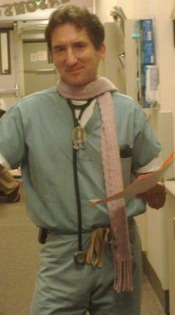
Christopher StookeyAbout Christopher Stookey

Christopher Stookey, MD, is a practicing emergency physician, and he is passionate about medicine and health care. However, his other great interests are literature and writing, and he has steadily published a number of short stories and essays over the past ten years. His most recent essay, “First in My Class,” appears in the book BECOMING A DOCTOR (published by W. W. Norton & Co, March 2010); the essay describes Dr. Stookey’s wrenching involvement in a malpractice lawsuit when he was a new resident, fresh out of medical school. TERMINAL CARE, a medical mystery thriller, is his first novel. The book, set in San Francisco, explores the unsavory world of big-business pharmaceuticals as well as the sad and tragic world of the Alzheimer’s ward at a medical research hospital. Stookey’s other interests include jogging in the greenbelts near his home and surfing (he promises his next novel will feature a surfer as a main character). He lives in Laguna Beach, California with his wife and three dogs.
To find out more about Chris, visit his Amazon’s author page at http://www.amazon.com/Christopher-Stookey/e/B003UVLDI4/ref=ntt_dp_epwbk_0.

Terminal CareAbout Terminal Care

Phil Pescoe, the 37-year-old emergency physician at Deaconess Hospital in San Francisco, becomes alarmed by a dramatic increase in the number of deaths on the East Annex (the Alzheimer’s Ward). The deaths coincide with the initiation of a new drug study on the annex where a team of neurologists have been administering “NAF”—an experimental and highly promising treatment for Alzheimer’s disease—to half of the patients on the ward.
Mysteriously, the hospital pushes forward with the study even though six patients have died since the start of the trial. Pescoe teams up with Clara Wong—a brilliant internist with a troubled past—to investigate the situation. Their inquiries lead them unwittingly into the cutthroat world of big-business pharmaceuticals, where they are threatened to be swept up and lost before they have the opportunity to discover the truth behind an elaborate cover-up.
With the death count mounting, Pescoe and Wong race against time to save the patients on the ward and to stop the drug manufacturer from unleashing a dangerous new drug on the general populace.


Read the Excerpt!

CHAPTER 1
The death itself wasn’t the unusual thing. The unusual thing was we tried to stop it. That first dying heart came on a Thursday night, a little after midnight on May 5th. I remember the date because it was Cinco de Mayo, a Mexican holiday. There’d been celebrations all day long in San Francisco, including in the Presidio where I was working that night.
I was one of two physicians on duty in the ER at Deaconess Hospital, doing the overnight shift, 6 PM to 6 AM. The early part of the shift had been busy. When I arrived at six o’clock, the waiting room was bursting with patients: drunken revelers with lacerations and sprained ankles, tourists with sunburns, picnickers vomiting from food poisoning, six members of a mariachi band with heat stroke and dehydration. We worked fast, moving from one stretcher to the next, seeing the most critical patients first and moving on.
Then, around ten o’clock, the flow of new patients stopped—abruptly, like water from a faucet turned from on to off. By 11:00 PM, there were only four patients in the waiting room. By 11:45, I finished sewing up my last laceration: a three-inch gash on the forehead of an intoxicated coed from San Francisco State.
Then, there was no one. The emergency department had gone from chaos to serenity.
With nothing to do, Hansen, the other physician on duty, went to catch a nap in the staff lounge. I washed up and went over to join Bill—the night nurse—at the nursing station. We sat with our feet up, drinking black coffee from Styrofoam cups, looking across the empty row of stretcher beds. Bill launched nostalgically into a pornographic tale about a buxom nurse he’d known while serving as a medic during the Gulf War. He’d just reached the climax—so to speak—of his story when, suddenly, the calm of the night was interrupted by an announcement over the intercom:
“Code Blue, East Annex, back station! Code Blue, East Annex, back station! ”
“Christ,” Bill said stopping short in his story. “East Annex? That’s the Alzheimer’s unit.”
“Yeah,” I said. Bill and I exchanged puzzled looks.
“Since when do they call Code Blues on the Alzheimer’s unit?” Bill asked.
The announcement came again, sounding now more urgent. “Code Blue, East Annex! Code Blue!” It was an urgent call for help, hospital jargon for, “Come quick, someone’s trying to die.” And, at that hour of the night, it was the duty of the ER doctor to come and stop the dying. Or at least to try.
I jumped up and grabbed the “Code bag,” the big black duffel bag filled with the equipment we’d need to run the Code: defibrillator unit, intubation tubes, cardiac meds.
“Let’s go,” I said.
“But I was just getting to the good part of my story,” Bill said.
“Save it for later.”
We ran out of the emergency department down the long connector tunnel leading to the East Annex. Why were they calling a Code Blue on the East Annex? I wondered as we ran. In my three years of working at Deaconess, this was the first time I’d been called to a Code on the annex. Normally, they didn’t run Code Blues on the Alzheimer’s ward. The patients there were “DNR”—“Do Not Resuscitate.” In other words, when a patient on the annex stopped breathing or went into cardiac arrest, nothing was to be done. No medical heroics. No breathing machines, no cardiac stimulants, no shocking the heart. This was considered the humane thing to do. All the patients on the annex had at least moderately advanced Alzheimer’s disease; all were near the end of life. To prolong the lives of these poor souls at all costs was not the aim of medical care on the East Annex. The aim of medical care on the East Annex was comfort, a safe environment, and, when the time came, death with dignity.
I heard Bill huffing and puffing, falling behind as we ran down the hall. I turned back and saw him slow to a walk.
“I’ll have to…meet…you…” he said breathlessly.
“Maybe if you give up those damn cigarettes,” I called back as I went around the bend in the tunnel.
“Maybe if…I was…a damn jogger like you,” Bill called out.
At the end of the connector, I came to the door leading to the second floor of the annex. Normally, the door was shut and locked. The East Annex was a locked ward because the patients there—at least the ones who were ambulatory—had a habit of wandering off the ward and getting lost when the doors weren’t locked. Now, as I reached the end of the connector, a rotund, uniformed security guard stood at the door holding it open for me. “Straight ahead, past the back station, on the left,” the guard said.
I went through the door and immediately someone shouted out. “Over here!”
I ran to where six or seven people were gathered outside one of the rooms. There’s always a crowd at any Code Blue. Death, either actual or imminent, is always something that fascinates people. Several of the people in the crowd had no business being there: for example, the ward secretary standing on her tiptoes peering in at the door and the two members of the janitorial staff looking over her shoulder.
Elbowing my way into the room, I got my first look at the patient: an elderly, gray-skinned woman wearing pink pajamas. She lay lifelessly on her back on the bed, the covers tossed back. Four people were gathered closely around the bed working on her. The ward tech, a muscular, crew-cut fellow, was performing chest compressions, pumping away on the old woman’s sternum with the heel of his hand. At the head of the bed stood the respiratory therapist, a skinny African-American fellow named Lamont—I had worked with him in the emergency department. Lamont was holding a mask over the patient’s face and squeezing breaths of oxygen from an oxygen bag. At the foot of the bed stood the Code Blue pharmacist, a young Hispanic woman I’d never seen before; she attentively held her tray of Code Blue medicines, ready to dispense whatever might be called for. The fourth person at the bed was Juanita Obregón, one of the East Annex night nurses. Juanita was also a familiar face. She’d been a good friend of mine since my early days at Deaconess. She stood opposite the ward tech, pressing her fingers into the patient’s groin, feeling for a pulse at the femoral artery.
“Pescoe!” Juanita said as I entered the room. Juanita always called me by my last name—not “Philip” or “Phil” or “Dr. Pescoe,” just “Pescoe”. “Thank God. I was in to see her twenty minutes ago, and she was absolutely fine, watching TV. Then, I came in to turn off the television, and she’s unresponsive. Not breathing, no pulse—out.”
Juanita stepped back as I came over on her side of the bed.
“Who called the Code?” I asked.
“I did,” Juanita said.
“Why? She’s an Alzheimer’s patient, isn’t she?”
“Yes,” Juanita said. “All the patients on the annex are Full Code now, while they’re running the study.”
“Study? What study?”
“Neussbaum and his team. They’re running a drug study, some new experimental treatment for Alzheimer’s.”
I looked at Juanita. I hadn’t heard anything about a drug study on the East Annex. Neussbaum, whom Juanita had referred to, was Tucker Neussbaum, the doctor in charge of the Alzheimer’s unit. He’d never said anything to me about a change in resuscitation status on the unit. Of course, now was not the time to start questioning DNR orders—if the little old lady in the pink pajamas had been declared a Full Code, then so be it. My job was to do everything I could to bring her back to life. Now.
I turned toward the ward tech. “Hold compressions,” I said.
The tech stopped pumping on the patient’s chest and stood back. I pressed my fingers into the old lady’s neck and felt for a pulse. Nothing. I unzipped the Code bag, turned on the defibrillator machine, and took out the defibrillator paddles. Tearing open the woman’s pajama top, I pressed the paddles against her bony chest. The paddles acted like heart monitor electrodes, and we all looked at the TV screen on the defibrillator machine. The neon light showed the woman’s heart tracing, a wiggly pattern running across the screen. The wiggly tracing meant there was still some “life” left in the old woman’s heart, still some electrical activity. The heart rhythm was not normal, however, far from it: the woman’s heart was quivering out of control in a rhythm called “ventricular fibrillation.” In order to save her life, something had to be done to stop the quivering. Otherwise, the woman would die.
“V-fib,” I called out. “I’m going to shock.”
I turned the knobs to charge the defibrillator just as Bill came into the room, wheezing like a steam engine.
“V-fib,” I said. “They’re running some sort of drug study, and all the patients are Full Code.” I pressed the paddles firmly down on the woman’s chest. “Stand clear!” I shouted.
Lamont and the ward tech stepped away from the bed, and I activated the defibrillator. A pulse of electricity shot through the woman’s chest causing her back to arch up. We all looked down at the monitor for the second it takes to re-establish the heart rhythm after the jolt of electricity. The neon tracing appeared on the screen, squiggly and still fibrillating out of control. The shock had failed to convert the old woman’s heartbeat to a normal rhythm.
“Okay,” I said, “epinephrine. We need an IV.”
“She already has one,” Juanita said. “Left forearm.”
I looked at the patient’s left forearm, and, just as Juanita said, there was an IV already in place. A rubber-tipped intravenous catheter had been secured with a gauze wrap and tape. The IV was further held in place by a fishnet stocking covering the entire forearm.
I looked at the pharmacist. “Epinephrine, one milligram,” I said. As the pharmacist reached into her box of medicines, I said to the ward tech, “Continue chest compressions. I’m going to intubate her.”
As in a choreographed dance, everyone went into action. The pharmacist took a syringe of epinephrine—adrenaline—from her tray and handed it to Juanita. Juanita injected the heart stimulant into the IV. The tech resumed his chest compressions, and Lamont resumed bagging oxygen to the patient. Meanwhile, I went to the head of the bed and prepared to put a plastic tube down the old woman’s throat so we could breathe for her more effectively.
They say much of emergency medicine is “cookbook medicine,” and a well-trained monkey can perform much of what emergency physicians do. There’s no better example of this than the Code Blue cardiac arrest. Every step in the Code is based on a precisely defined algorithm, and everyone knows the drill. We’d already performed the first step of the algorithm: shock the patient’s heart with 360 Joules of electricity. This had failed to stop the quivering, so we moved to the next steps of the protocol: a shot of intravenous epinephrine and intubation.
“7.5 tube,” I said.
Bill took the throat tube out of the Code bag and handed it to me. Lamont pulled off the oxygen face mask and stepped aside, and I checked the woman’s mouth to see if there was anything inside that might make it difficult to put the tube down—blood, loose dentures, chunks of food. Her mouth and throat were clear.
“Does this patient have any history of heart problems?” I asked Juanita as I put the laryngoscope blade into the mouth and pried open the jaw.
“No, that’s just it,” Juanita said. “Her only medical history is Alzheimer’s disease. Otherwise, she’s the healthiest patient on the ward. Then again, that’s what I said about the last patient who died. This is the second Code we’ve had in three days.”
“Oh?” I said slipping the throat tube into the trachea.
“Yes. Mrs. Messing, she died on Tuesday.”
Lamont attached the oxygen bag to the end of the tube and began pumping 100% oxygen directly into the woman’s lungs.
“Is Neussbaum here tonight?” I asked.
“No. He just left, half an hour ago,” Juanita said. “His resident is on call tonight, Dr. Chester Mott. He’s here.” Juanita motioned with her head toward a young man standing on the other side of the room.
I looked over at the man. I hadn’t noticed him before; he was slumped down in the shadows of the far corner of the room. He was a short, overweight fellow wearing a black tee shirt and surgical scrub pants; he had carrot orange hair that stood out in all directions. He looked like a resident, all right: young, disheveled, sleep-deprived. I figured he must have been sleeping in the call room when the Code was called.
“Okay, hold compressions,” I said. I looked at the heart monitor: the rhythm was still v-fib. Our efforts were getting us nowhere. “Let’s shock again, 360 Joules.”
Bill charged the machine to 360, and I delivered the shock. Again, no change. What’s more, the amplitude of the heart waves on the screen was getting smaller, flatter. It was a bad sign.
I looked over at the resident. “Want to help, do some chest compressions?” I asked.
The resident looked at me with wide, frightened eyes and shook his head, no. I felt my head cock sideways as I looked at him in surprise. No? That’s odd, I thought. Residents were supposed to be keen to jump in and get involved in a Code Blue. Even if they’re nervous and not really eager to do so, at least they’re supposed to pretend. That’s what they’re there for, to learn. However, I decided to cut Dr. Mott some slack. No doubt he was feeling overwhelmed and anxious, the way most residents feel during the heat of a cardiac arrest. If this had been his rotation through the emergency department, I would have insisted. However, this was the Alzheimer’s ward. The young Dr. Mott was supposed to be learning about dementia and urinary incontinence and bed sores, not fibrillating hearts. No need to press him into service if he didn’t feel comfortable with it.
“Continue compressions,” I said turning back to the tech. I looked at pharmacist. “Amiodarone, 300 milligrams, IV,” I said regurgitating the next step of the protocol.
We continued to work down the algorithm, delivering further shocks and further medications. The room became pungent with the smell of the patient’s singed flesh owing to the repeated shocks. Another bad sign. Between shocks and injections, I watched and supervised the Code team. The ward tech had worked up a heavy sweat pumping away at the chest compressions.
“Need a break?” I asked.
“No, I’m okay.”
“Bill can relieve you. Or,” I said raising my voice a little, “maybe the resident.” Mott didn’t move. He just stood there looking down at the floor, his hands folded diffidently over his protuberant belly.
“No, I’m fine,” the tech said; “I’m good.”
I looked at the patient lying lifelessly on the bed. I wondered what it was that had caused her heart to go suddenly haywire. Heart attack? Juanita had said there was no history of heart problems. I looked at the old woman’s face: she had to be at least eighty-five-years-old. Her hair was white and thinned to near baldness at the crown, her forehead covered with age spots. Her cheeks stood out prominently on the bony face, and her eyes were sunk deep into the sockets. I asked myself again: why in the world were we Coding this bent-up old lady with Alzheimer’s disease?
I asked the tech to hold compressions and looked once again at the heart monitor. The tracing was almost flat now. The woman was going to die. I knew it, everyone knew it—we were just going through the motions now.
“Okay,” I said. I could hear the resigned tone in my own voice. “Let’s try another shock—360 Joules.”
We continued our efforts for another ten minutes until the woman’s heartbeat was truly flat-line on the monitor. I delivered one final, ineffective shock then decided to call it quits.
“I’m going to stop,” I said. “Any objections?”
Not surprisingly, no one objected.
“Okay…,” I said looking up at the clock on the wall. “12:57.”
The tech stopped the chest compressions; Lamont stopped squeezing the oxygen bag; the pharmacist closed her box of medicines. Somewhere in the shadows I saw the young Dr. Mott slip silently out of the room. I looked down at the patient. Her face was now a blue-purple color, and the endotracheal tube stuck out of her mouth like the end of a large fish hook.
“Okay,” Juanita said. “12:57. I’ll mark it down as the time of death.”

banner bar

Terminal Care Tour Schedule

banner bar
Tuesday, September 7
Guest blogging at As the Pages Turn
Wednesday, September 8
Book reviewed at Life in Review
Thursday, September 9
Guest blogging at Blogging Authors
Friday, September 10
Book reviewed at Rundpinne
Monday, September 13
Interviewed at Literarily Speaking
Tuesday, September 14
Interviewed at The Writer’s Life
Wednesday, September 15
Book reviewed by Book Reviews by Buuklvr81
Thursday, September 16
Guest blogging at The Book Boost
Friday, September 17
Book Reviewed by My Reading Room
Monday, September 20
Interviewed at Pump Up Your Book
Interviewed at Let’s Talk Virtual Book Tours
Tuesday, September 21
Guest blogging at Literarily Speaking
Wednesday, September 22
Book reviewed at Marta’s Meanderings
Thursday, September 23
Interviewed LIVE on A Book and a Chat Radio Show (click link for details)
Friday, September 24
Book reviewed at You Have How Many Kids?
Monday, September 27
Book reviewed at Ohio Girl Talks
Tuesday, September 28
Book reviewed at Celtic Lady’s Reviews
Wednesday, September 29
Book reviewed at From the TBR Pile
Thursday, September 30
Book reviewed at Reading at the Beach
OCTOBER DATES TO BE ANNOUNCED

banner bar


Giveaway:  Since my bookshelves are overflowing, I'm going to give my gently read copy of Terminal Care away.  Open to US/Canada only.  Leave all entries in one post please for this one.  To enter all you have to do is comment and leave your email addy.  For extra entries follow me (GFC Friend, RSS, email subscription, Goodreads friend, Like My Reading Room on Facebook, Twitter (@cfulcher)), you can also tweet 1 entry per day.  For 10 extra entries tell me why you want to read this book. Giveaway ends 9/24b.

Thursday, September 16, 2010

Unfair reviews

Bet that caught your attention - no I'm not talking about bloggers today.  I find bloggers are very fair in their reviews and state the fact when they give a low-rated review that it's their opinion and often go into detail about why they didn't like the book.  That is fair.  Bloggers do not have to write glowing reviews of books when they didn't like the book.  I think a lot of us struggle with writing reviews that are less-than-stellar because we don't want to hurt the author, but we read, we blog and we review so occasionally there are some books that don't quite line up with what we expected.  Again this is all fair.

What I am talking about are the people giving books 1 star ratings on Amazon because of the Kindle prices.  I saw this yesterday with Nicholas Sparks' newest book, Safe Haven.  Now I will be the first to admit his books are not literary genius, but you know what - I truly enjoy his novels, as do many other people obviously.  Yes they can be sappy and yes they can be sad, but he transports me to a place that is just outside my backdoor (I live in coastal NC) and his stories always captivate me and take me away for awhile.  Brain candy is what I call them.  So giving Safe Haven a 1 star review because it's $12.99 (which is a publisher decision not an author decision) is truly unfair.  If you don't like the book say so, give it a one-star review and tell me why, but don't punish an author because of the price of his book.  This isn't the first book that this has happened to and it won't be the last.  I wish Amazon could do something to stop this type of review, but then that is censorship and I don't want to go there either. 

I guess what is unfair is some people will see that 1-star review and steer away from the book.  Do I truly think the 1-star review will hurt Nicholas Sparks - no way - but what about a first-time author or a fairly new author that this happens to - that is where it becomes truly unfair.

So what is the point - I'm not sure, I just needed to vent and simply say - it's okay to not like books, it's okay to post bad reviews of books, but don't post bad reviews based solely on the price of the book (now if you wanted to say book x is definitely not worth the price because the plot stinks really bad then that is okay).  Complain to Amazon, complain to the publisher about the pricing, but don't hurt the author - they have nothing to do with the pricing models that are set up.  On top of that, don't buy the book, but again don't write a bad review simply because you don't like the  price.

I know I am preaching to the choir, but I just had to get it off of my chest - it's been bothering me since I read the review on Tuesday when the book came out.

Off soapbox now and back to your regularly scheduled sedate book review blog. :)

FIRST Wild Card Tour: Petra: City of Stone by T.L. Higley

It is time for a FIRST Wild Card Tour book review! If you wish to join the FIRST blog alliance, just click the button. We are a group of reviewers who tour Christian books. A Wild Card post includes a brief bio of the author and a full chapter from each book toured. The reason it is called a FIRST Wild Card Tour is that you never know if the book will be fiction, non~fiction, for young, or for old...or for somewhere in between! Enjoy your free peek into the book!

You never know when I might play a wild card on you!


Today's Wild Card author is:


and the book:


B&H Books (September 15, 2010)

***Special thanks to T.L. Higley for sending me a review copy.***

My review will be coming next week, it's been crazy and I have only managed to read a little of this book - but it is good so far.

ABOUT THE AUTHOR:


Tracy started her first novel at the age of eight and has been hooked on writing ever since. After attending Philadelphia Biblical University, she earned a B.A. in English Literature at Rowan University. She then spent ten years writing drama presentations for church ministry. A lifelong interest in history and mythology has led Tracy to extensive research into ancient Greece, Egypt and Rome, and shaped her desire to shine the light of the gospel into the cultures of the past. She has traveled through Greece, Turkey, Egypt, Israel, Jordan and Italy to research her novels, and looks forward to more travel as the series continues.


Visit the author's website.

Product Details:

List Price: $ 14.99
Paperback: 344 pages
Publisher: B&H Books (September 15, 2010)
Language: English
ISBN-10: 1433668564
ISBN-13: 978-1433668562

AND NOW...THE FIRST CHAPTER:


The streets of Rome lay barren and empty, sucked dry by the colossal Flavian Amphitheatre that had swallowed seventy-five thousand Roman citizens in a single gulp, and would hold each one captive until they had enjoyed the horrors that Julian now raced to prevent.

More time. He needed more time. Already the crowd inside the four-story rim of stone cheered for the first event.

Julian’s sandals smacked the black basalt road that led toward the amphitheatre. The blistering Roman sun pounded the moisture from his skin and left him panting. He had run most of way, since an old servant in Vita’s house had pointed a gnarled finger toward the east, toward the Forum, toward the arena of death.

Eighty arches ringed the outside of the theatre on each of its first three stories. The bottom arches provided access to the public, and the second story’s niches held statues of the gods and emperors, who now looked down on Julian as he sprinted across the large travertine slabs that paved the arena’s edge.

He ran toward one of the four main entrances and fumbled for the tessera, the stone tile he wore around his neck. The designatores at the entrance would insist on examining it, to see the sector, row and seat to which he was assigned.

Indeed, the usher at this entrance was full of his own importance, and held a palm to Julian’s oncoming rush as though he could stop him with only the force of his arm.

“Too long in your bed this morning, eh?” His smug smile took in Julian’s hastily-wrapped toga and sweat-dampened hair.

Julian thrust the tessera before the man’s eyes. “Here, here, look at it.”

Still the amused smile. The usher opened his mouth to speak again.

“Look at it!”

Daunted, the man let his eyes travel over the tile, then took a tiny breath and stepped back. His grin faded to a look of regret over his own impudence, and he bowed his head. As if that were not enough, he bowed at the waist and extended a hand to invite Julian to enter.

Julian did not wait for an apology. He pushed past the usher and under the vaulted entrance, then straight through the arena’s outer corridor and up a ramp that led to the cavea, the wedge-shaped sections of marble seats. This main entrance led directly to the central boxes reserved for the elite.

He exploded from the dimly lit ramp onto the terrace. The morning sun slashed across half the seats, the height of the amphitheatre leaving the other half in shade. The red canvas velarium, the awning used to shade the spectators, would be raised before it got much hotter, but for now, thousands of bleached togas on white marble blinded the eye and the smell of the masses assaulted the nose.

Julian crossed the terrace in two strides, slammed against the waist-high wall that separated him from the arena, and saw a figure dash at him from the shadows.

His mother’s hands were on his arms in an instant. “Julian, what are you doing?” Her words were frantic, as clipped and terror-filled as his every movement.

“They have Vita, Mother!”

She wrenched his body fiercely to face her. Julian stood nearly a cubit taller than his mother, but Ariella had retained all the strength of her youth, along with the beauty. “There is nothing that can be done, my son.”

He yanked his arms from her grasp. “Do not say that!” Julian searched the cavea behind him, full to overflowing with the purple-edged togas of senators. “Where is Father? Is he here?”

“Julian, think! You must think.” Ariella’s voice was urgent and low and her clutching fingers again slowed Julian’s restlessness. “You will bring more harm – “

“I do not care!” His voice snagged with emotion, and he fought to harden the feelings into action. “I must end this.”

“You cannot, son.”

He turned flashing eyes on Ariella. “It is my fault! Do you not understand? I should be down in those cages.”

Ariella’s eyes misted. “I would not lose both my son and his betrothed on the same day.”

Betrothed. The word washed more guilt over Julian’s stricken soul.

A senator, one of his father’s friends, walked past and paused to hold out an arm in greeting to Julian. “Fine day for the games, is it not?”

Julian straightened at once, resuming the noble bearing trained into him since childhood, and returned the man’s grip. He nodded once in agreement, but did not speak. The senator moved on, and Julian dropped his shoulders, ashamed that he had not made a statement.

Ariella seemed to read his thoughts. Her dark eyes held his own. “It will take more than a day to change the Empire.”

Julian looked out over the yellow sand of the arena. “But this day, Mother, this day we must!” He slapped a hand against the top of the marble wall. “I am going to find Father.”

“Julian, you know that he can do nothing – “

He spun on her. “No. I am tired of both of you, always moving about your circles quietly, behind closed doors, the truth spoken only in whispers.” He lifted his own voice as an example. “There is a time to speak!”

Ariella’s nostrils flared, but she said nothing. Turning from her, Julian stalked to the nearest break in the seating and ascended the tiers alongside his father’s section. Here, the nobility did not sit on wooden planks as the rest of the citizens, but were given cushions or even chairs for comfort. He scanned the rows of seats for his father’s graying head, and instead met his dark gray eyes.

Julian shook his head and opened his mouth to shout across the intervening seats, but his father held up a hand, then stood and excused himself from his colleagues. He slid along in front of a dozen other senators, and emerged at the end of the row beside Julian.

Quietly, he spoke into his son’s ear. “I have just now heard. It is outrageous.”

Julian’s hands balled into fists at his side. “You must do something.”

“What can I do, Julian? The emperor has ruled, and Trajan is not a man to be defied.”

Across the arena, Julian watched as a trapdoor slid upward and a huddled band of men and women were prodded onto the sand at the end of Roman spears. Julian’s heart pounded with the shortness of the time left and he turned on his father with the frenzy of desperation. “She is out there, Father!”

But his father’s eyes held only grief, not anger. Not the fiery anger that could change the future, even now.

Julian pushed past him, down the steps. If his parents would do nothing from their positions of influence, then he would stop this madness from a position of strength.

It had been his fault, all of it. Trajan had made his stance clear. As long as they kept to themselves, did not flaunt their disagreement with imperial policy, did not take a public stand, they would be left alone. But that had not been enough for Julian. Passionate about the truth, eager to show himself a leader and foolish enough to believe himself invincible, he had spoken too loudly, in too many places.

And now this. Vita and the others arrested, convicted, and sentenced without his knowledge. Julian had brought this on them all, but he had escaped their fate.

At the terrace level he circled the arena toward the imperial box. The amphitheatre was one of the few places where the public had access to the divine emperor. Julian grasped at the thin hope that he could get near enough to plead for Vita’s life.

He had not loved her. Not like he should, though he had tried. He had never known a more virtuous woman. The arranged match between them was a good one. But Julian had never felt more than the flame of admiration and respect for her, and he saw nothing but the same in her eyes. Still, they would have been married.

We will be married.

The foot-stomps of the crowd rose around him like a hundred thousand drumbeats. The cadence resonated in his chest and pushed him forward. He knew that sound. It was the sound of a mob hungry for blood.

Terror drove his footsteps. He could not look to the arena. Not even when he heard more trapdoors rise and the low growl of beasts begin.

The crowd screamed as one, and their shouts lifted to the pale blue sky like a puff of evil smoke from the underworld. Julian’s bones seemed to turn to water. He raced on. The emperor’s raised box was in sight.

But then they were beside him again, both his parents this time, grasping at his arms, pulling him backward.

“It is too late, son.” His mother’s voice held the grief of both the present and the past, for she had seen much sorrow in the arena in her day.

His father turned him to the wall to face the sand. “You must say goodbye, Julian. You must say goodbye.”

He let his parents hold him there at the marble wall. He scraped his hands across the top, then gripped the white stone.

Lions. Six of them. Circling, circling the knot of friends in the center of the bright yellow sand that had been brought from one of the hills of Rome and spread on wooden planking to soak up the blood of gladiator, beast, and the condemned.

The lions charged at once, but for Julian, the moment stretched out, like a thread of silk spun from a slow-turning wheel, and though the crowd still bellowed, in his head all had gone silent and he saw only his group of friends, crumpling in on themselves like sand flowing into a sinkhole.

The lions must have roared before they pounced, though Julian heard nothing, and felt only the relentless scraping of his own hands across the stone wall. He scraped until his hands were torn and bloody, wanting to bleed with her, wanting to bleed with all of them, as he should have.

The sun had risen to pour its rays into the center of the arena, and the yellow sand beneath them turned to molten gold in the light, an oval of liquid gold with Vita and the others drowning in the center of it. He saw her face for a moment, lifted to heaven.

His mind disconnected and drifted strangely, then, to the words at the end of the Apostle John’s Revelation, and his vision of the New Jerusalem with its streets of pure gold.

Would Vita fall asleep in this golden sand and wake to streets of gold?

The beasts did their job well and quickly, and when it was over and the mutilated bodies of his friends lay scattered across the sand, Julian woke from his stupor and felt the guilt of every lost life bear down on him as though the stones around him had collapsed on his head. He tasted bile rising in his throat, and turned away from the wall to retch onto the paving stones.

His parents held his arms as he emptied the contents of his stomach. He heard the jeers directed toward him. When he stood, the tear-streaked faces of both his parents matched his own.

But he found no solace in their shared grief. They did not have to bear the guilt of it as he did. As he always would. He pulled from their embrace and escaped the amphitheatre, running back the way he had come, running like a haunted man.

Days later, when his guilt and grief had hardened into bitter anger, he tried once again to change the minds and policies of the Roman government. But in the end he brought only more disgrace, and more danger, upon his family.

In the cool of the evening three days after Vita’s death, he stood at the terrace wall of his father’s lavish villa in the Roman countryside, looking down into the flowered gardens his mother had commissioned, and listening to the fountain that trickled night and day into the central pool. He inhaled deeply of the night air, dragging in the scent of roses.

His guilt over Vita’s death had not abated, and he had added to it with his actions in the days since. His brazen words in the Senate House, and later the Forum, had identified him as one who should have also met his death in the arena that day.

Perhaps that was his wish. To be arrested himself, to be thrown before the gaping yaw of a dozen lions, to be given what he deserved.

But his family. He had not wanted the same for his family. His only brother, long since stationed in some military outpost, had never embraced the family’s beliefs, but even he could be reached by the long arm of the empire, and brought back to face condemnation with the rest.

Behind him, slaves stirred to prepare the evening meal and lit torches on the veranda. His parents would appear soon and they would all pretend that their privileged life continued.

But Julian had made a decision. His life in Rome was over. To protect his family, he must disappear.

He thought of his brother’s stories of the provinces that lay at the edges of the Empire. Of Britannia, of Judea. But even there the Roman army could search out a man. No, he must go further east than even Judea.

There was a place, a hidden city he had heard tales of since he was a boy. Stories that had sparked his imagination and given him the desire to travel across the desert sand to discover the city tucked between the rock cliffs of Arabia.

Petra. Capital of the Nabatean kingdom, wealthy center of the east-west trade route, and beyond even the Roman Empire’s reach.

Julian rubbed his hands together, palms still raw from being torn open the day Vita died. Yes, it was a good plan.

He would flee to Petra.


Wednesday, September 15, 2010

BlogFest 2010: The Winners


Wow - it doesn't get much more amazing than that.  I believe BlogFest 2010 was a success.  Many thanks go out to Cinnamon at A Journey of Books for all she did to coordinate this.  I made my way through a lot of the blogs and I have even found out I won something aready!  The best thing though is new blogs to read, that is what I love about things like BlogFest.  I gained new followers and for that I thank all of you - new and old followers alike.  (My husband still wants to know if I can command you to do things, but I told him it's not that kind of followers).

Also I apologize to all international people - I really wish I could open my giveaways internationally, but I am strapped for cash right now, with the economy like it is and my husband self-employed there is not a lot of spare money at the moment.  I don't have advertisers on my blog so I don't make money at this therefore I have to do what I can.  I will try to do an international giveaway again soon.

So on to what you want to know - who won my giveaways.  I think this was my most-participated giveaways to-date with 143 people entering to win The Fall, 193 people entered for Maybe Next Time and 163 entered for You.  This was the individuals entering, not the total number of entries.


The Fall: Book Two of the 
Strain Trilogy
An ARC of The Fall by Guillermo Del Toro and Chuck Hogan (I just finished The Strain and can't wait to read this one), there were 453 total entries and entrant 7 was the winner:

Brooke (texas_gal45)

 Maybe This Time 
An ARC of Maybe This Time by Jennifer Crusie- 572 entries total, winning entry: 199

Melissa Robinson-Arezzi

You
An ARC of You by Charles Benoit - 503 total entries - winning entry - 49

Tanya904


Thanks to all the participants, the winners have been notified by email and have 48 hours to contact me or I will redraw a name.